Estate Planning Beyond Assets: A Structural Approach to Preventing Family Fracture
Estate Planning Beyond Assets: A Structural Approach to Preventing Family Fracture
Introduction
Estate planning has traditionally been framed as a legal and financial exercise. Advisors and attorneys often focus on tax efficiency, document preparation, and the orderly transfer of wealth. While these components are essential, they represent only a fraction of what is truly at stake.
Increasingly, both academic research and real-world outcomes suggest that the most significant risk to families is not taxation or probate delay, but relational breakdown following wealth transfer.
This article explores a more comprehensive framework for estate planning, one that moves beyond documentation and into structural design. Specifically, it examines how poorly constructed plans contribute to family conflict, why common practices such as appointing the oldest child as executor can be problematic, and how modern approaches, including Trust Investment Advisor (TIA) structures and strategic trust situs selection, can mitigate these risks.
The Limitations of Traditional Estate Planning
Conventional estate planning models tend to prioritize technical completion over functional effectiveness. In practice, this often results in three recurring issues:
-
Absence of Planning: A significant portion of families lack any formal estate plan, leaving asset distribution subject to state intestacy laws.
-
Incomplete Implementation: Many plans are drafted but never properly funded, rendering them ineffective when needed.
-
Misaligned Authority Structures: Roles such as executor or trustee are assigned without sufficient consideration of family dynamics or long-term governance.
While each of these issues presents its own risks, the third is particularly consequential. Even a technically sound estate plan can fail if authority is concentrated in a way that creates perceived inequity among beneficiaries.
The Psychological Dimension of Estate Distribution
A growing body of behavioral research underscores the importance of perceived fairness in family systems. According to studies published by institutions such as the American Psychological Association, individuals evaluate fairness not solely based on outcomes, but on perceived intent and relational signaling.
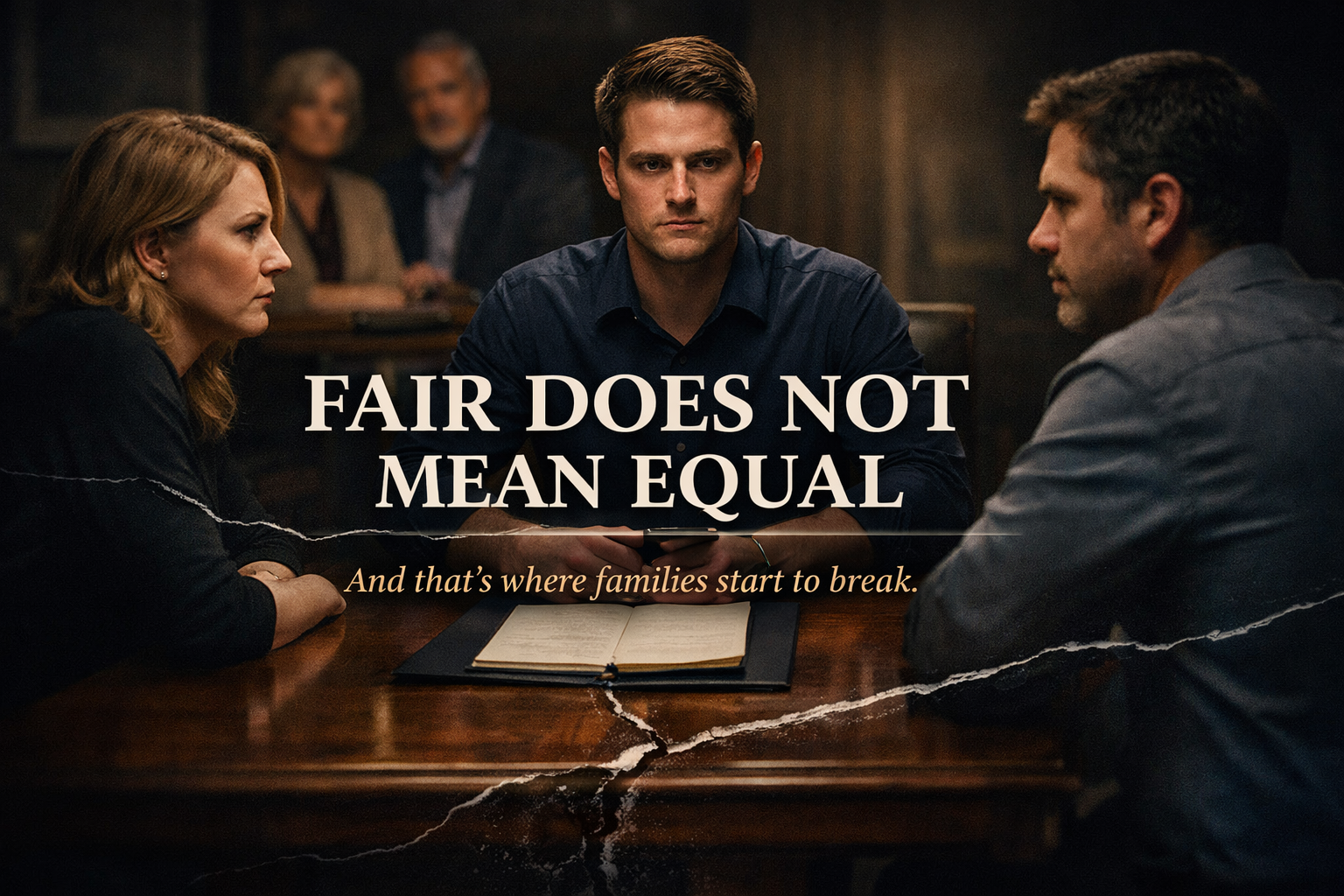
When a parent appoints one child to a position of authority, such as executor or trustee, the decision carries symbolic weight. While the intention may be rooted in trust or practicality, other children may interpret the decision as a reflection of relative value or favoritism. This divergence between intent and perception is a primary driver of post-settlement conflict.
In this context, the widely accepted practice of naming the oldest child as executor warrants closer examination. While often justified by assumptions of maturity or responsibility, this default decision can unintentionally introduce hierarchy into sibling relationships at a time when emotional sensitivity is heightened.
Executor Selection and Structural Risk
The role of executor or trustee is inherently complex. It involves fiduciary responsibility, decision-making authority, and, in many cases, discretionary judgment. When this role is assigned to a single family member, several risks emerge:
-
Concentration of Power: One individual holds decision-making authority over others with equal economic interest.
-
Perceived Bias: Even neutral decisions may be interpreted as self-serving or preferential.
-
Emotional Burden: The appointed individual must navigate both administrative responsibilities and interpersonal dynamics.
These risks are not mitigated by the competence or integrity of the individual selected. Rather, they are inherent to the structure itself. As such, the question is not simply who should be appointed, but whether the role should be structured differently altogether.
Reframing the Objective: From Asset Transfer to Relationship Preservation
A more advanced approach to estate planning begins by redefining its primary objective. Instead of focusing exclusively on the efficient transfer of assets, the goal becomes the preservation of family cohesion alongside wealth continuity.
This reframing has significant implications for how plans are designed. It shifts the emphasis from individual roles to system architecture, from personal trust to institutional clarity, and from static documents to dynamic processes.
At ePIC Services Company, this philosophy is central to the planning process. The objective is not merely to complete an estate plan, but to design a system that functions effectively under real-world conditions, including emotional stress and generational transition.
The Role of Structural Design in Conflict Prevention
Effective estate planning structures share several key characteristics:
-
Separation of Responsibilities: Distinct roles are assigned to different parties, reducing the likelihood of perceived conflicts of interest.
-
Clarity of Authority: Decision-making frameworks are clearly defined, minimizing ambiguity.
-
Reduction of Discretionary Conflict: Wherever possible, decisions are guided by predefined rules rather than subjective judgment.
One of the most effective mechanisms for achieving these outcomes is the use of a Trust Investment Advisor (TIA) structure.
Trust Investment Advisor (TIA): A Structural Solution
The TIA framework represents a significant evolution in trust design. Under this model, investment authority is separated from administrative and distribution responsibilities. This allows for a more balanced allocation of power and reduces the likelihood of interpersonal conflict.
Key advantages of the TIA structure include:
-
Decoupling of Roles: Investment decisions are handled independently from beneficiary interactions.
-
Professional Oversight: Advisors can serve in a formalized capacity, maintaining continuity and expertise.
-
Conflict Mitigation: By removing unilateral control from any single family member, the structure reduces the potential for disputes.
For a deeper exploration of how directed trust structures function, readers may refer to resources from the American College of Trust and Estate Counsel (ACTEC), which provides detailed analysis of fiduciary role design.
The Strategic Importance of Trust Situs
Another frequently overlooked component of estate planning is the selection of trust situs, or the jurisdiction under which the trust is governed. Many individuals assume that their trust must be established in their state of residence. However, this assumption can limit the effectiveness of the plan.
Certain jurisdictions, such as Nevada, South Dakota, and Delaware, have developed highly favorable trust laws that offer:
-
Enhanced asset protection
-
Greater administrative flexibility
-
Support for directed trust structures, including TIA
-
Extended trust duration provisions
According to data from sources such as the Tax Foundation and state-level trust law analyses, these jurisdictions have become increasingly attractive for high-net-worth planning. By strategically selecting situs, families can access legal frameworks specifically designed to support long-term wealth preservation and governance.
Completion Versus Functionality
In recent years, many firms have begun to emphasize "end-to-end" estate planning, including document drafting and funding assistance. While this represents progress, it does not fully address the challenges discussed above.
A truly effective estate plan must satisfy three criteria:
-
Completion: All documents are properly drafted and funded.
-
Comprehension: All parties understand their roles and responsibilities.
-
Functionality: The structure operates effectively under real-world conditions.
At ePIC, the planning process integrates all three elements through a combination of attorney-reviewed documents, a dedicated onboarding and funding process, and an Outsourced Estate Planning Team (OEPT) that guides clients through implementation. Additionally, ePIC University provides advisors with the education necessary to navigate estate planning conversations without crossing into the unauthorized practice of law.
The Advisor’s Role in the Next Decade
As the Great Wealth Transfer accelerates, advisors are increasingly positioned at the center of multigenerational decision-making. Research from firms such as Cerulli Associates estimates that tens of trillions of dollars will change hands over the coming decades, with significant implications for client retention and relationship continuity.
In this environment, advisors who limit their role to investment management may find themselves displaced during generational transitions. Conversely, those who engage in estate planning as a relational strategy are more likely to maintain long-term client relationships.
This requires a shift in perspective. Estate planning is not an ancillary service. It is a foundational component of client engagement, one that addresses both financial and interpersonal dimensions of wealth.
Conclusion
The challenges associated with estate planning are not primarily technical. They are structural and relational. While traditional approaches emphasize documents and tax efficiency, a more comprehensive framework recognizes the importance of governance, perception, and family dynamics.
Naming the oldest child as executor may appear to be a logical decision. However, without a supporting structure, it can introduce unintended consequences that undermine both family cohesion and the effectiveness of the plan.
By contrast, approaches that incorporate role separation, TIA structures, and strategic situs selection offer a more robust solution. These frameworks do not rely on individuals to manage complexity and emotion. Instead, they are designed to function predictably and equitably, even under stress.
Ultimately, the objective of estate planning should extend beyond the transfer of assets. It should aim to preserve relationships, maintain alignment, and provide a stable foundation for future generations. In this sense, the most successful estate plans are not those that simply distribute wealth, but those that sustain the families who inherit it.